
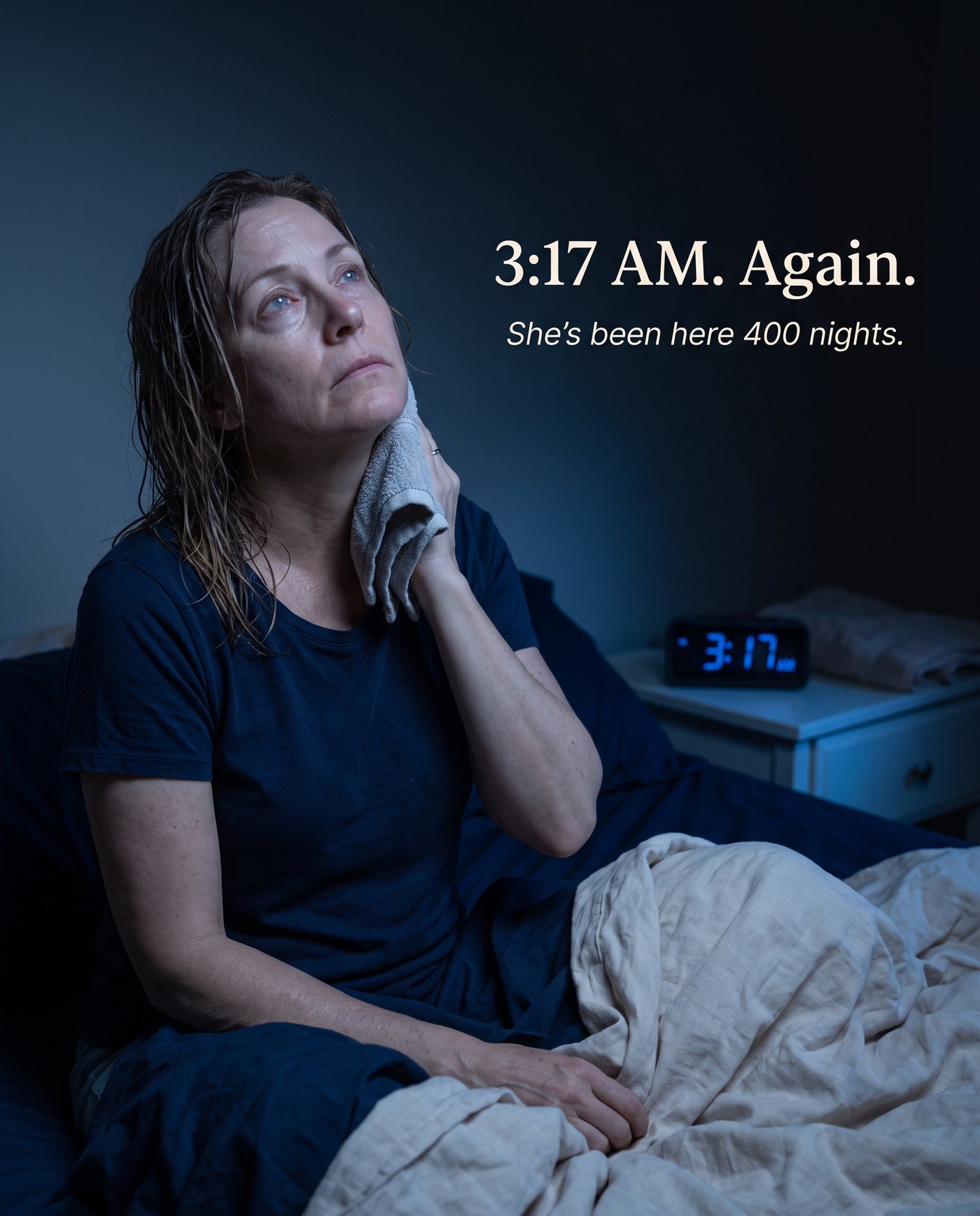
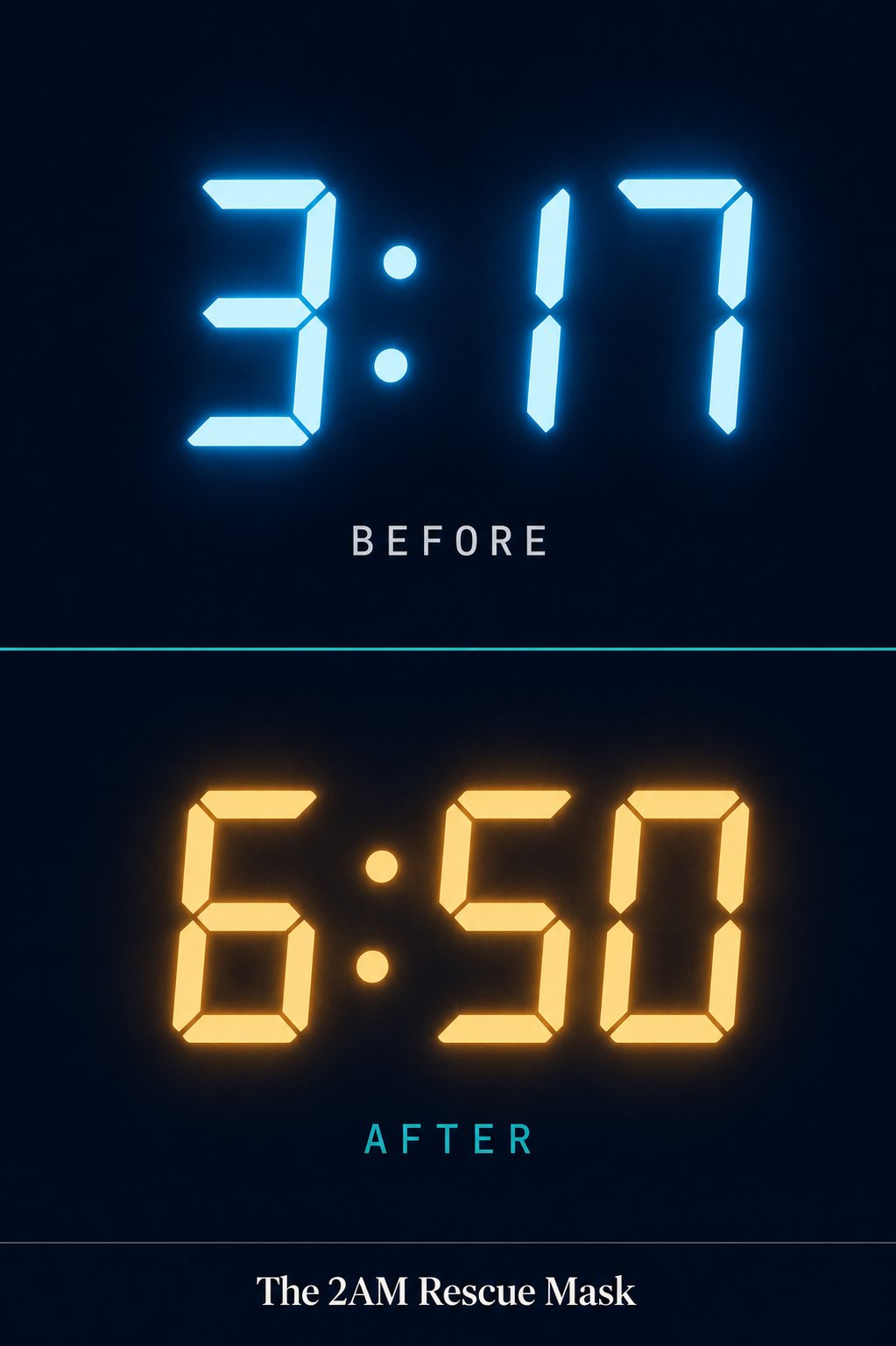
Let me tell you what 3:17 AM looked like in my bedroom for three years.
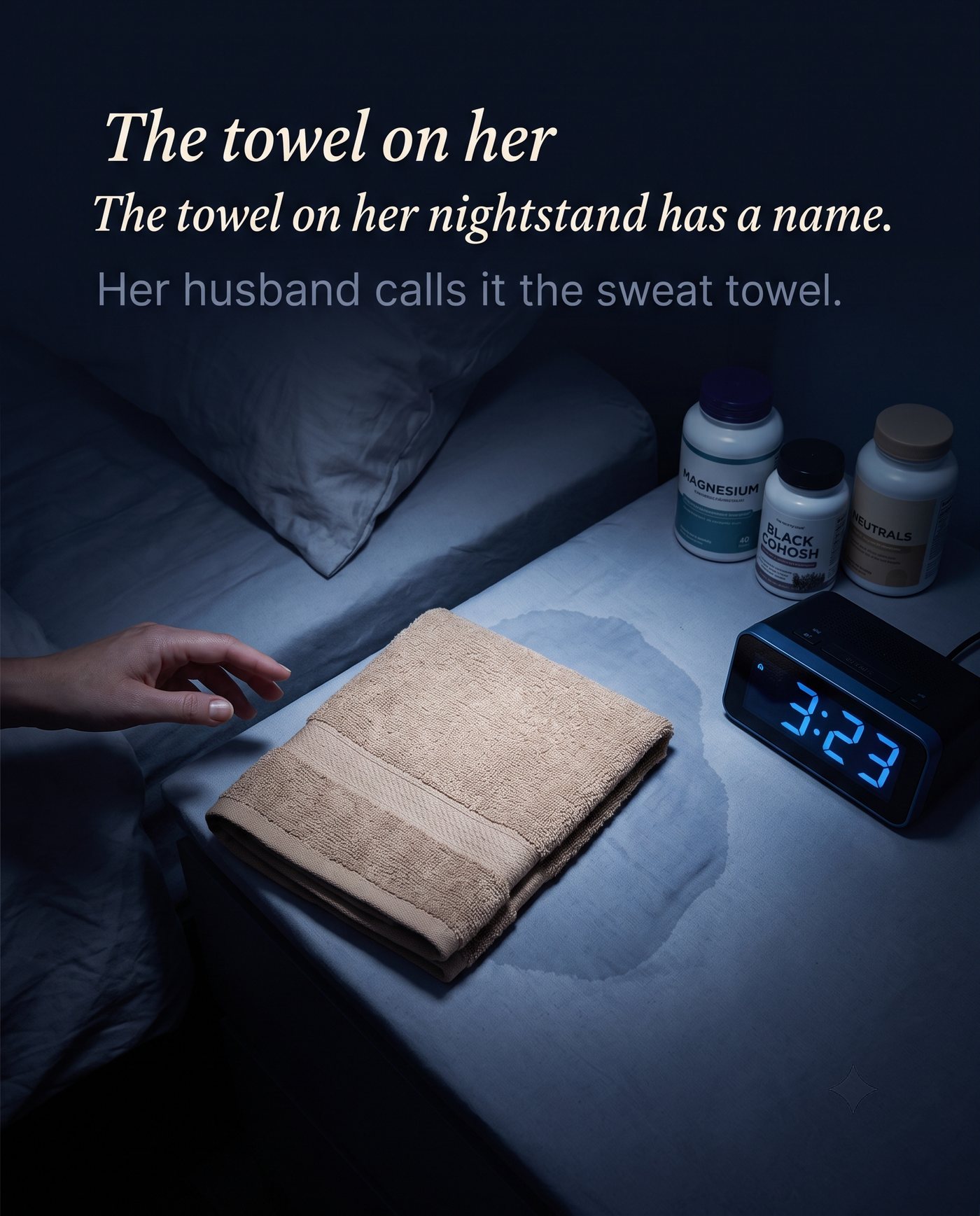
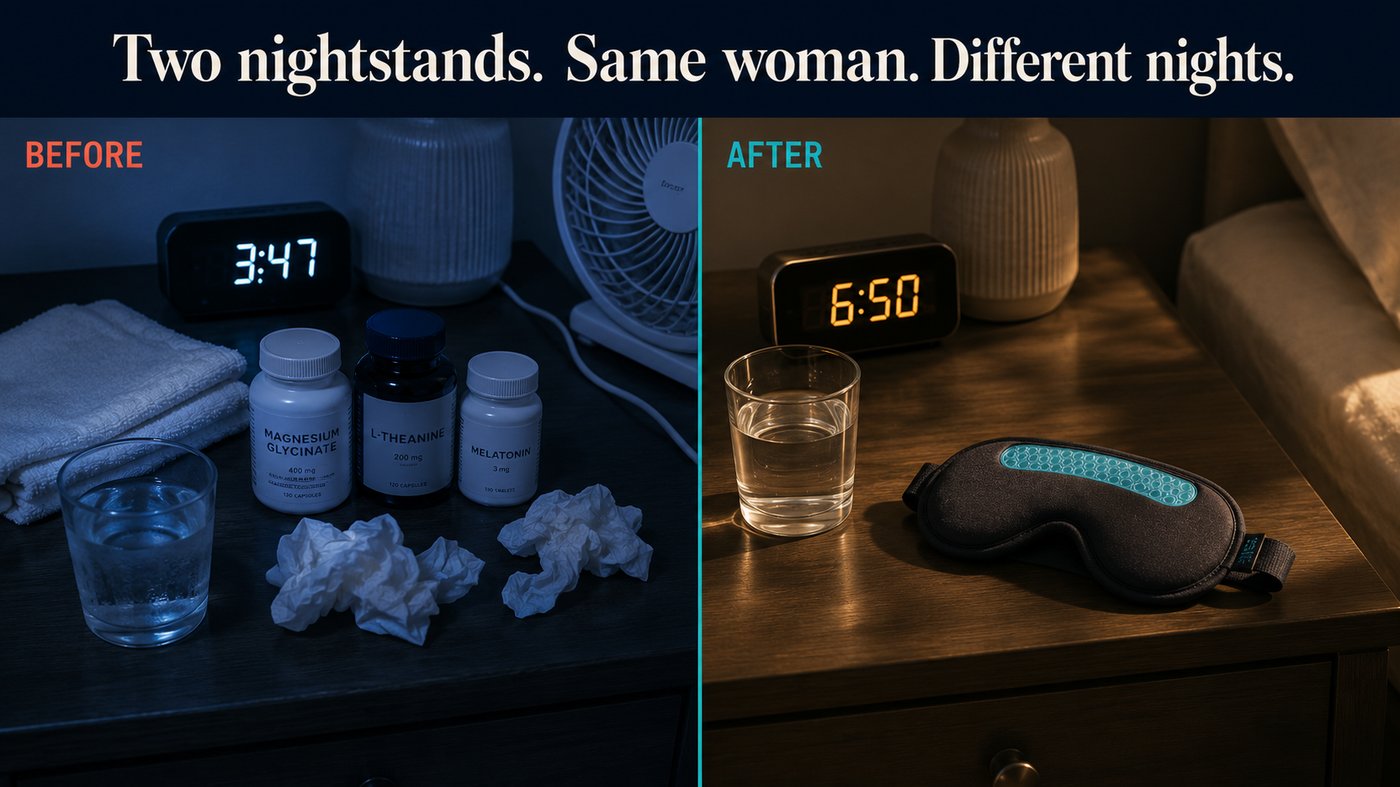
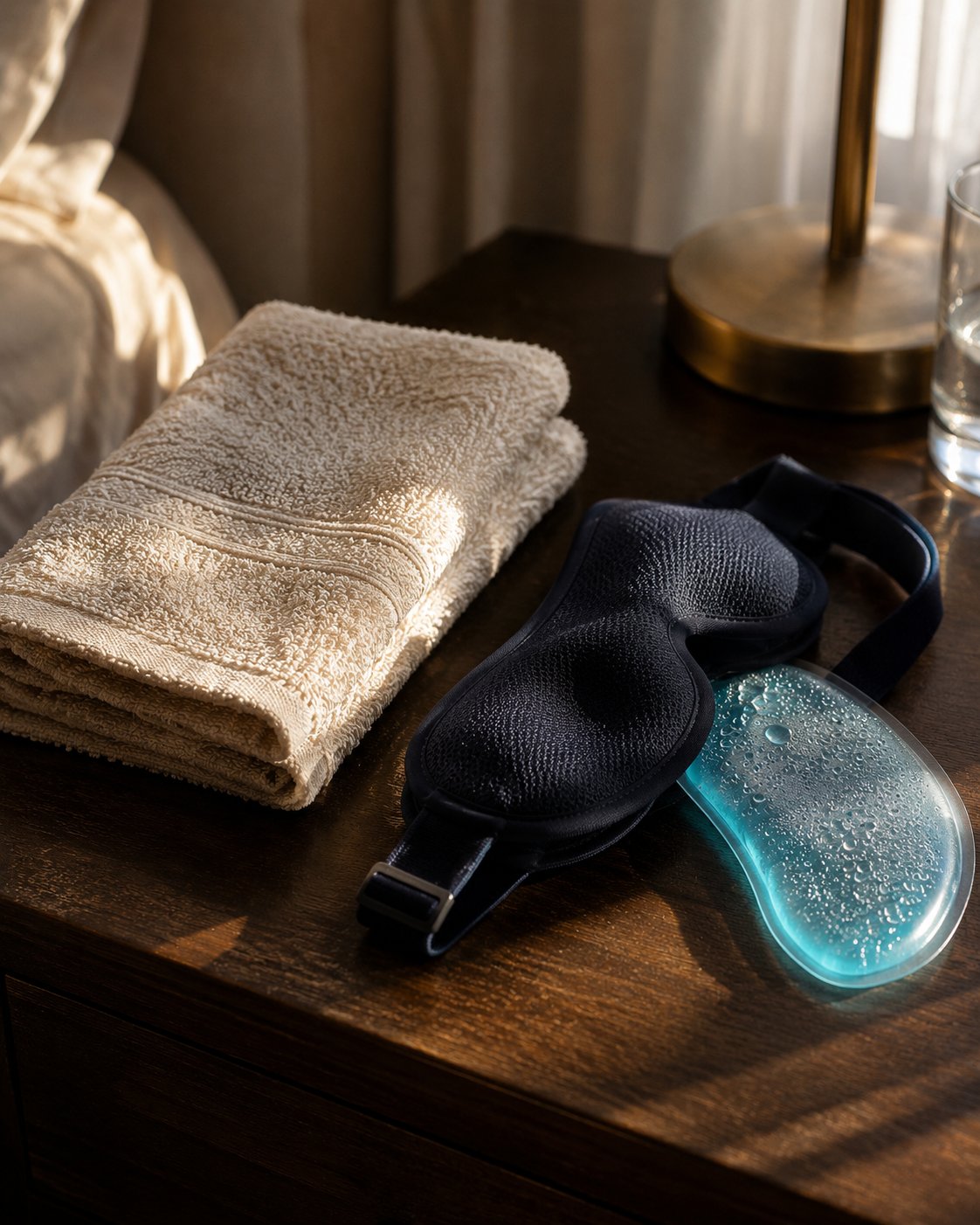
There's a hand towel folded on my nightstand. Not a face cloth — a full hand towel. My husband calls it my "sweat towel." I call it the thing I reach for before I'm even fully awake, because by then my pillow is already past saving.
I wake up with my heart pounding. Not racing gently — pounding. My hair is plastered to the back of my neck. There's sweat pooling in the creases of my eyelids, which I didn't even know was physically possible until this started. I kick the covers off. I lie there for a moment, radiating heat, staring at the ceiling fan, telling myself it'll pass.
Then the shivering starts. Because damp skin in cool air does what it always does.
So I reach for the towel. I lay it over the wet patch on the sheets. I pull a dry corner of the duvet over my freezing legs. I listen to my husband breathe and wonder, for the four hundredth time, if I am ever going to sleep like a normal person again.
And here's the part nobody really talks about: it's not just the heat. It's what happens in your head after the heat. By the time the shivering starts, my brain is already awake and running. Tomorrow's meeting. The email I forgot to send. The weird thing my boss said last week. The fact that I've walked into the kitchen and forgotten why I'm there three days in a row — and whether that's just tiredness or something I should be more afraid of.
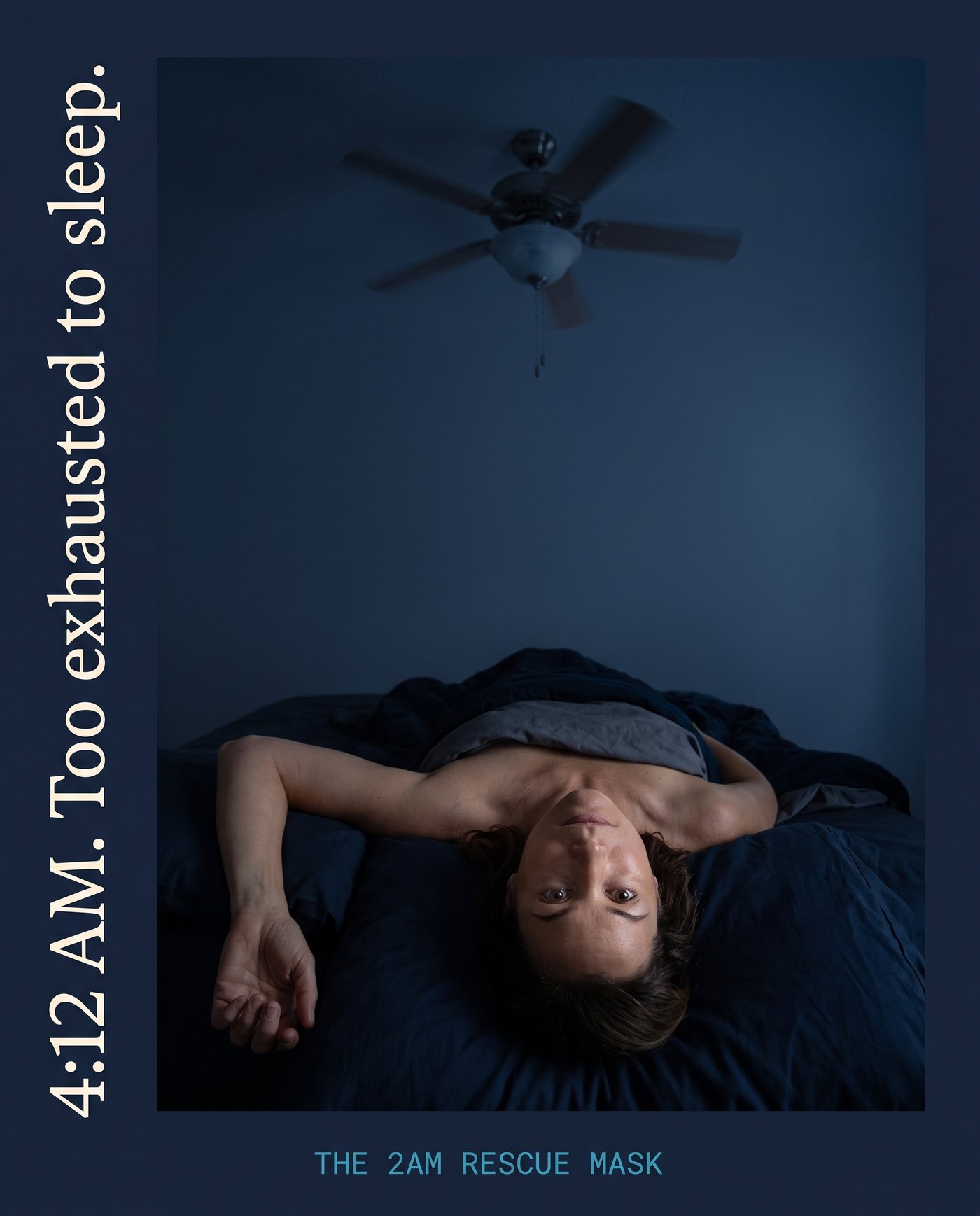
By 4AM, I'm not hot anymore. I'm just awake. Exhausted and awake. Watching the ceiling get slowly lighter.
Somewhere in those hours I thought about the woman I used to be. The one who had a second gear. Who could push through a hard day and still have something left for the people she loved. I wasn't grieving the sleep exactly. I was grieving her.
I did this for three years.
Why Everything I Tried Didn't Work
I want to tell you what I tried — because I need you to understand I wasn't passive about this. I researched. I spent money. I was desperate in that very organized, very thorough way that women who are used to solving problems tend to be desperate.
The "cooling" sheets. I spent $180 on a set that promised to wick moisture and regulate temperature. They felt cool for approximately forty seconds when I first got into bed. By midnight, they were warm sheets. Damp, warm sheets. Because that's what fabric does — it absorbs whatever heat you give it and holds it. Calling a sheet "cooling" is like calling a sponge "draining." It takes in the water. It doesn't stop the flood.
The bedside fan. My husband lasted four nights before he started sleeping with a pillow over his head. Also: if you've ever had a fan blowing directly onto sweaty skin, you know it doesn't actually cool you down so much as it dries out your sinuses and gives you a low-grade headache by morning. I was waking up hot and congested, which is a genuinely impressive combination of miserable.
Beyond the fan, the bedroom temperature itself had become a nightly negotiation I resented having. I wanted 64 degrees. He could sleep comfortably at 70. Neither of us was wrong. Both of us were losing. The thermostat became a small, quiet war we never quite talked about.
The supplements. Magnesium glycinate. Black cohosh. A specific blend marketed to women "navigating hormonal changes" that cost me $60 a month and, if I'm being honest, did nothing I could actually measure. Not at 3AM. Not in the moment when I needed something to physically happen in my body, right now, immediately.
The BedJet. I researched it for two solid weeks. Four hundred dollars for the single-zone version. The consistent complaint across dozens of reviews: the air blows into your face and dries everything out, and the motor noise bothers partners. I didn't buy it.
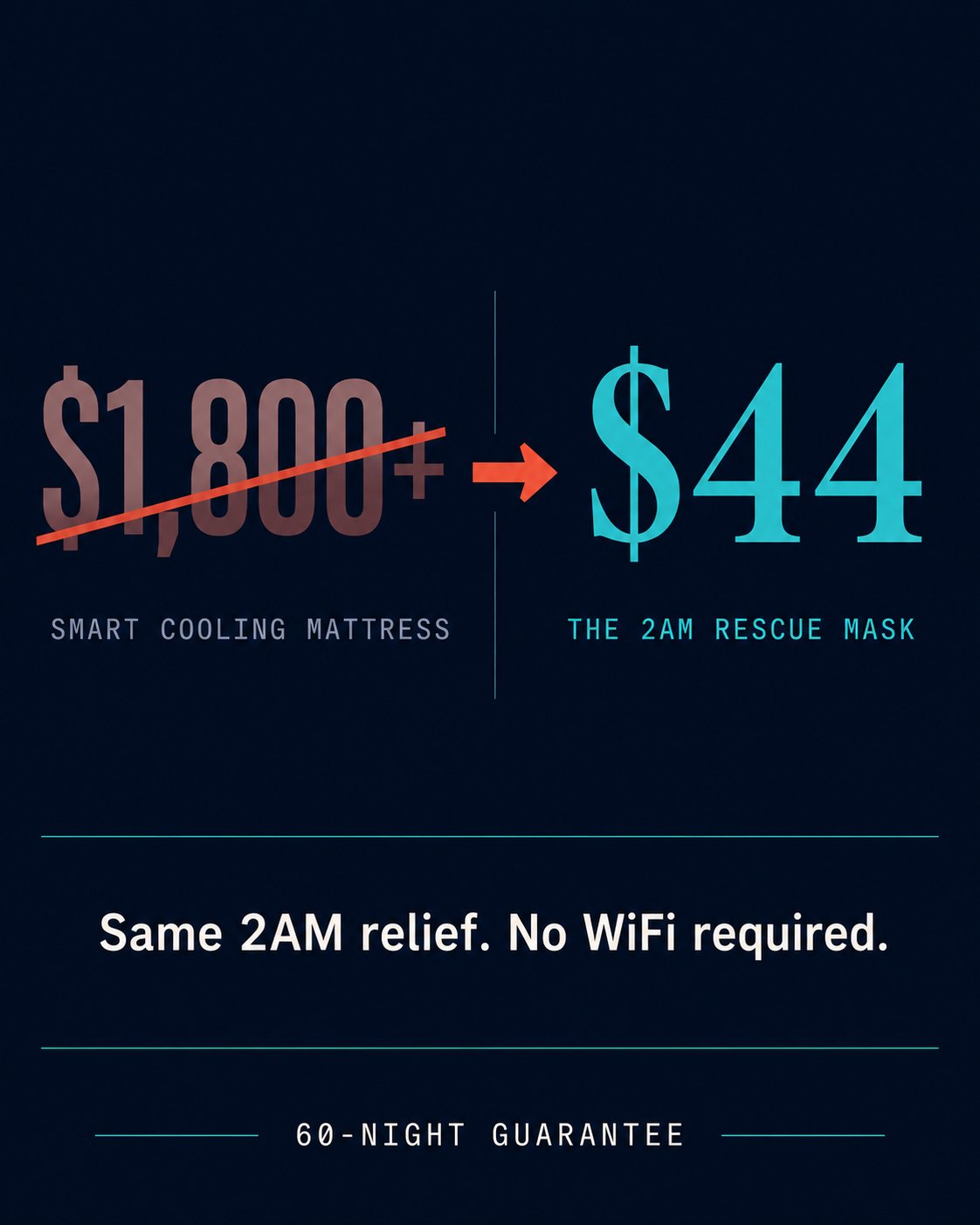
Eight Sleep. Two thousand dollars. Requires WiFi. Has known leaking issues. Needs a separate temperature profile for each partner. I stared at the product page for a long time, did the mental math on my marriage, and closed the browser.
I eventually arrived at a place — and I think a lot of women know exactly where this place is — where I simply accepted it. I stopped researching. The towel on the nightstand became furniture. I started keeping a spare in the drawer. I told myself at least the sheets were dry by morning.
When I mentioned it to my doctor, she suggested I try to reduce stress.
I remember sitting in the parking lot afterward, engine off, not ready to go back inside to anything. There's a particular kind of loneliness in being told your body's emergency is a mood to manage. I had walked in hoping for someone to say: here is what is happening, and here is what we do about it. I drove home with a pamphlet about sleep hygiene and ordered a supplement I didn't believe in.
The Thing My Friend Said
Last spring, I was having coffee with a woman I've known for fifteen years. She's a therapist. We were talking about sleep, in that way women our age talk about sleep — like it's a country we used to live in and can't find our way back to.
She mentioned that one of the techniques she uses with patients experiencing acute panic attacks is to have them submerge their face in cold water. Or, when that's not possible, to splash ice-cold water across their eyes and forehead, and hold it there.
I asked her why that worked.
She said something that I kept thinking about for the next three days.
"Because your body has a reflex. When cold hits the nerve system in your face, your heart rate drops almost involuntarily. It's called the Mammalian Dive Reflex. The moment a mammal's face enters cold water, the heart slows. It's one of the fastest ways known to interrupt an acute physical stress response — faster than breathing exercises, faster than medication in many cases."
— Therapist friend, over coffee last springI sat with that.
The nerve system in your face.
Heart rate drops almost involuntarily.
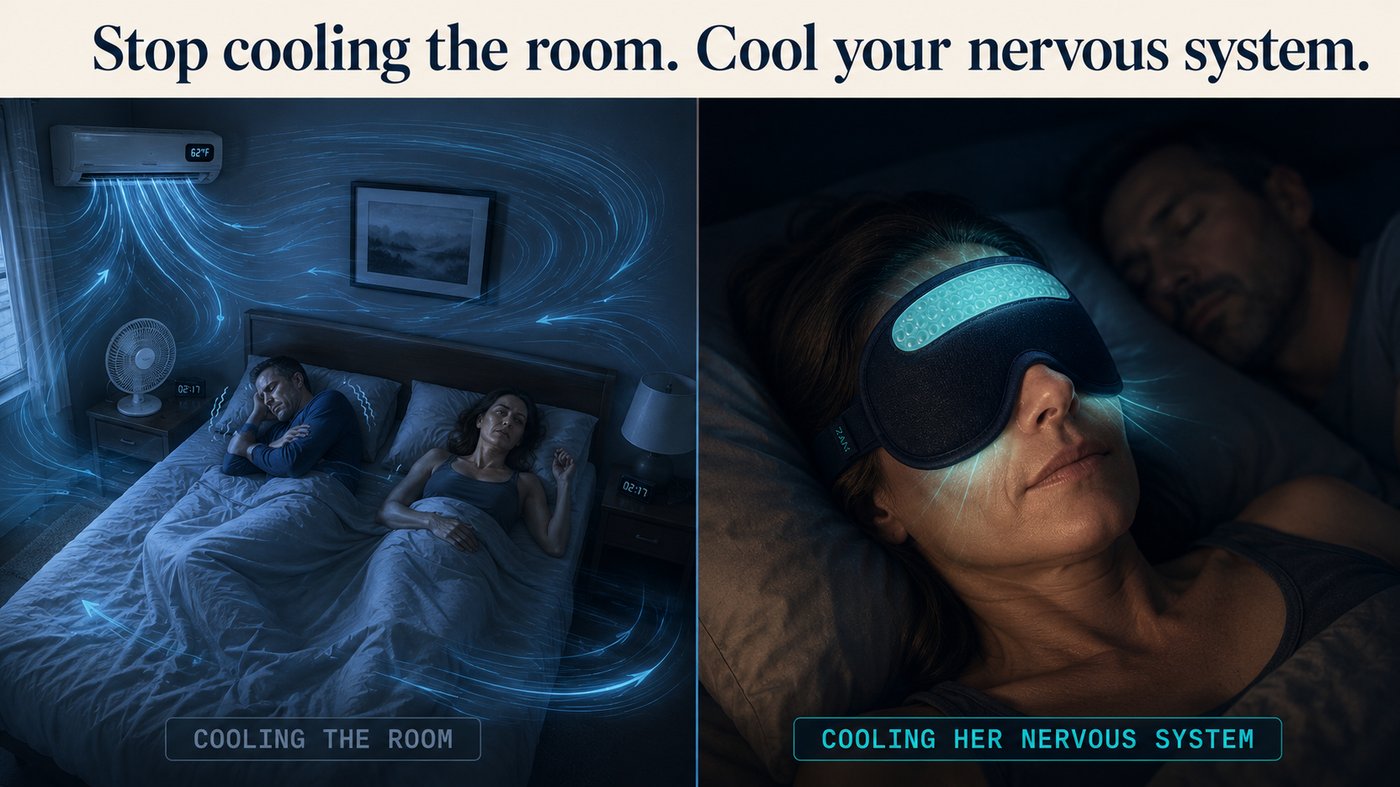
I thought about the pounding at 3AM. I thought about lying awake at 4AM, too wired to sleep, too exhausted to do anything else. And I thought about the fact that every solution I had ever tried — every sheet, every fan, every supplement, every $2,000 system I'd nearly bought — was aimed at cooling the room. The bed. The air.
Not my face.
Not my nervous system.
Not the thing that was apparently controlling whether my heart slowed down or kept hammering.
What I Found When I Started Digging
I went home and researched the Mammalian Dive Reflex. And what I found was a body of physiology that the entire sleep product industry had apparently never bothered to explain — or perhaps never knew existed.
When cold contacts the trigeminal nerve — the nerve running through your forehead, eyes, and the bridge of your nose — it sends a near-instantaneous signal to the vagus nerve. The vagus nerve is the body's natural brake pedal for the cardiovascular system. When it activates, the heart slows. Parasympathetic dominance switches back on. The technical term is "rest and digest." The plain language version is: your body physically downshifts.
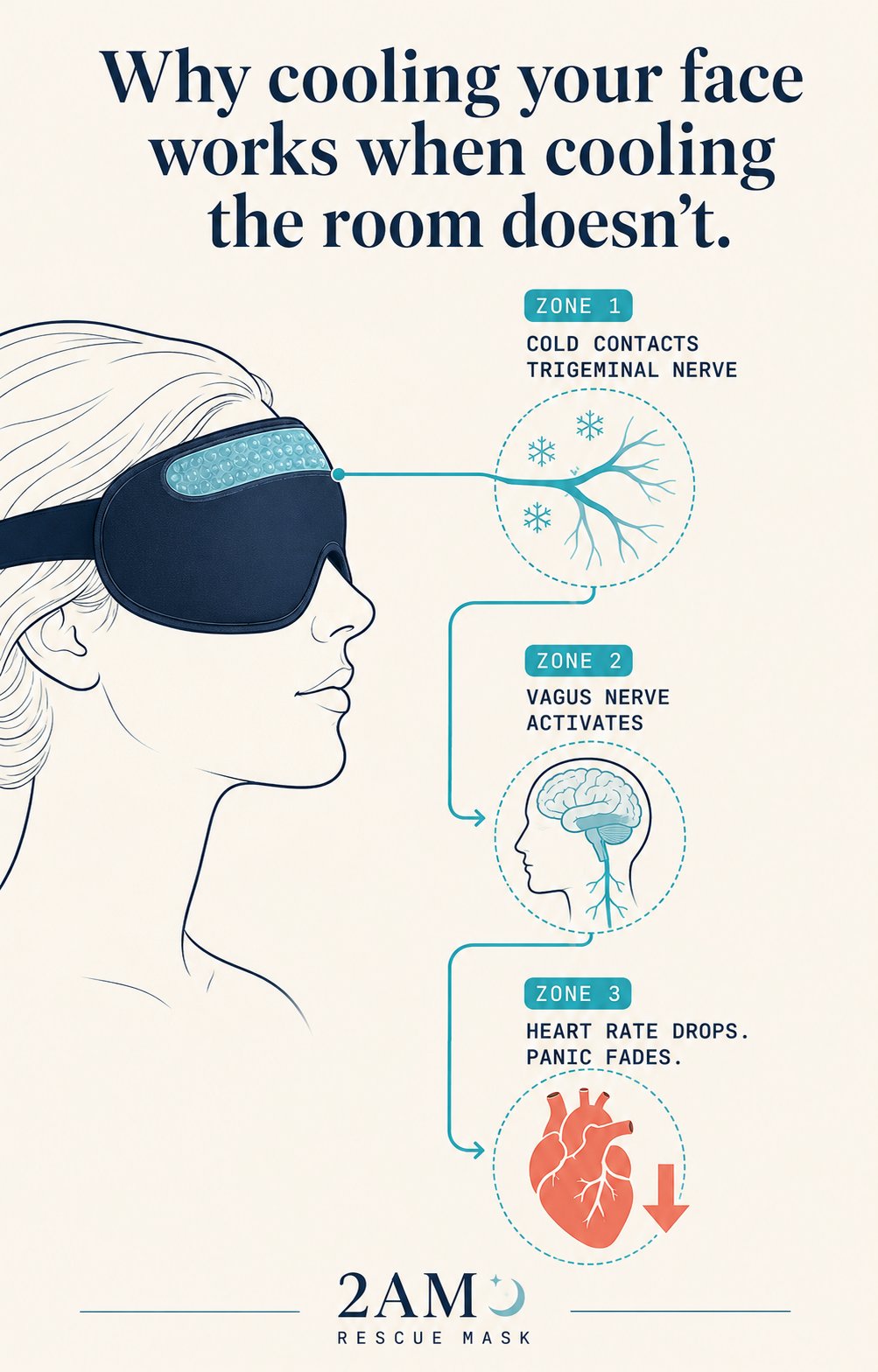
This is why cold water on the face stops a panic attack faster than breathing techniques. This is why therapists teach it. This is documented physiology, peer-reviewed, not a wellness trend.
And it meant something that I genuinely had not considered in three years of researching this problem.
A racing heart at 3AM is not a temperature problem. It's a physiological trigger.
— Karen M.No sheet was ever going to reach my trigeminal nerve. No fan pointed at the ceiling. No supplement dissolving in my bloodstream at a pace measured in weeks.
For three years, I had been trying to solve a nervous system problem with a fabric solution.
What I didn't yet know was where that realization was going to lead me — or whether it was going to lead anywhere practical at all.
The Problem With What I Tried Next
The morning after coffee with my therapist friend, I did something that felt almost embarrassingly simple.
I went to the freezer, took out the ice pack I normally use for my lower back, wrapped it in a dish towel, and left it on my nightstand.
3:20 AM. The heat hit. Heart pounding, hair wet, the familiar ceiling-stare beginning. I reached for the ice pack and pressed it across my eyes and forehead.
It worked. Not completely, not instantly — but within about ninety seconds I felt my heart rate begin to actually drop. The edge came off the panic. My breathing slowed. The heat didn't vanish, but the emergency quality of it did. I drifted off somewhere around 4AM, which was an hour earlier than usual.
I lay there thinking: this is the most useful thing I've learned in three years.
Then I thought about the practical reality of maintaining this solution indefinitely.
The ice pack had warmed up and slid off my face twice. The dish towel was soaked. There was a wet patch on my pillow. I had briefly woken my husband retrieving it from the nightstand. And crucially — I had turned on my phone screen to check the time, twice, which I only later understood was actively working against me.
The mechanism was right. The delivery was a disaster.
What I Actually Needed
I started researching this more specifically. Not "cooling sleep products" — I had years of evidence about where that search led. I was looking for something much more precise.
A way to apply cold to the trigeminal nerve — eyes, forehead, bridge of nose — without having to get out of bed. Without turning on a light. Without dripping water on the sheets or disturbing my husband. Something I could reach for in the dark, half-asleep, and apply in under thirty seconds.
I found a thread on a menopause forum where someone had posted almost exactly this question. The replies were the usual mixture — wet washcloth, ice in a zip-lock, the $400 BedJet recommendation that surfaces everywhere. But one response, buried about halfway down, described something different.
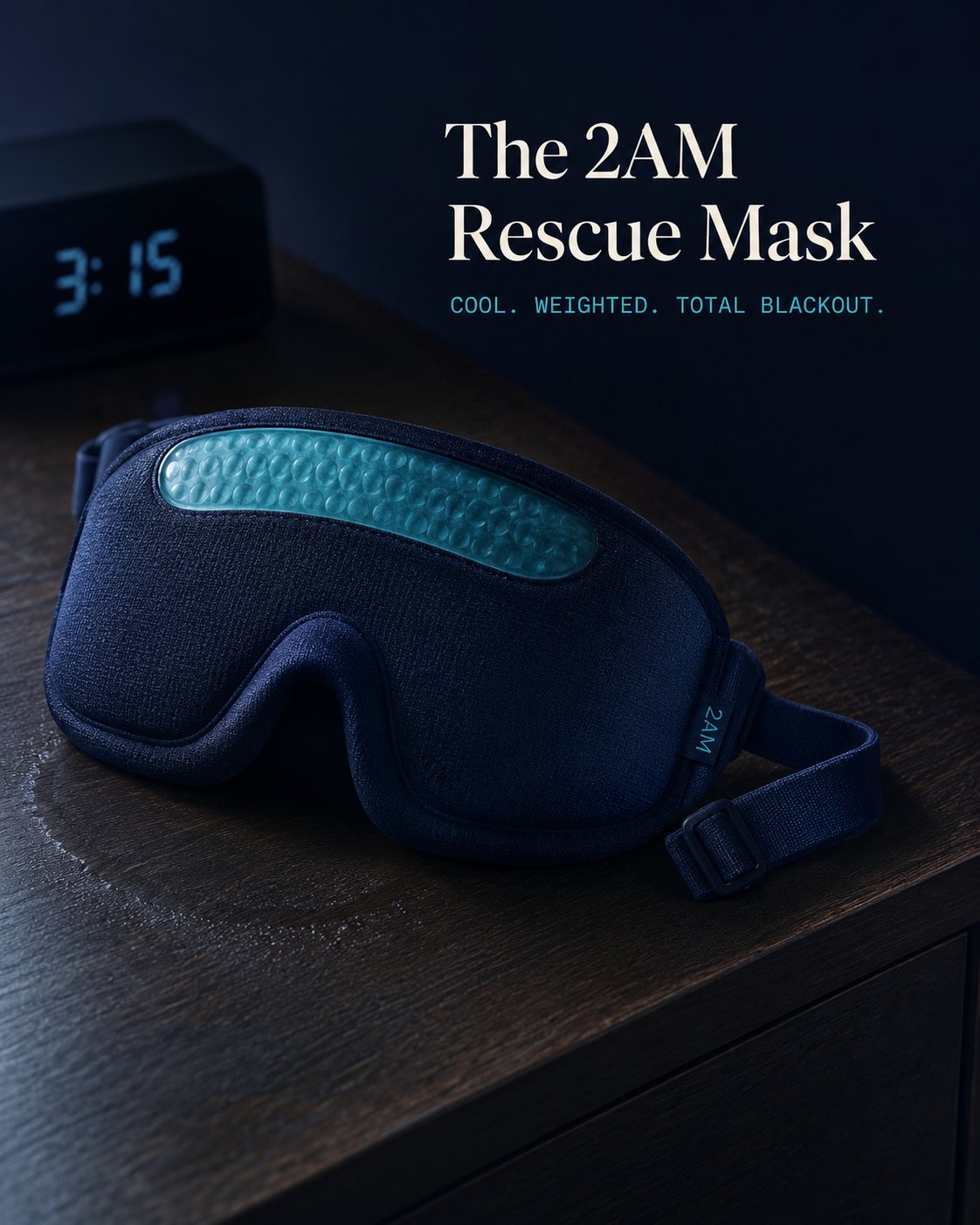
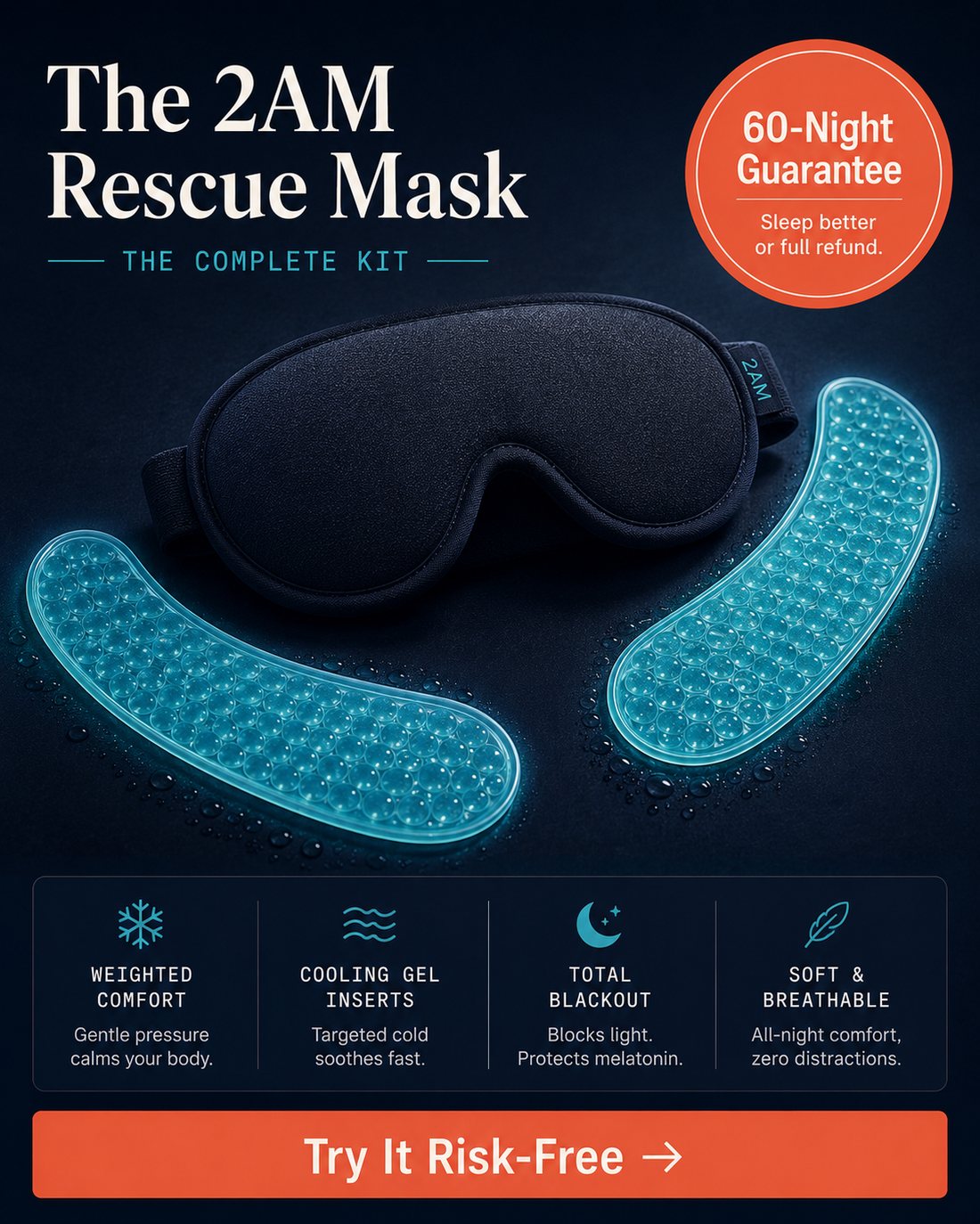
A weighted cooling mask. Gel insert you keep in the fridge. Designed specifically for this use case — not for migraines, not for travel, not for beauty sleep. For the exact 2AM scenario I had been living in for three years.
I want to be precise about my skepticism here, because it was specific. I had already tried a generic gel mask — the kind sold for migraines. I kept it in the freezer. It came out rigid, like a piece of plastic. It sat on my face for about four minutes before the condensation started dripping. The strap was a thin elastic band that had already snapped once. It did not stay on my face through any form of movement. I had thrown it away.
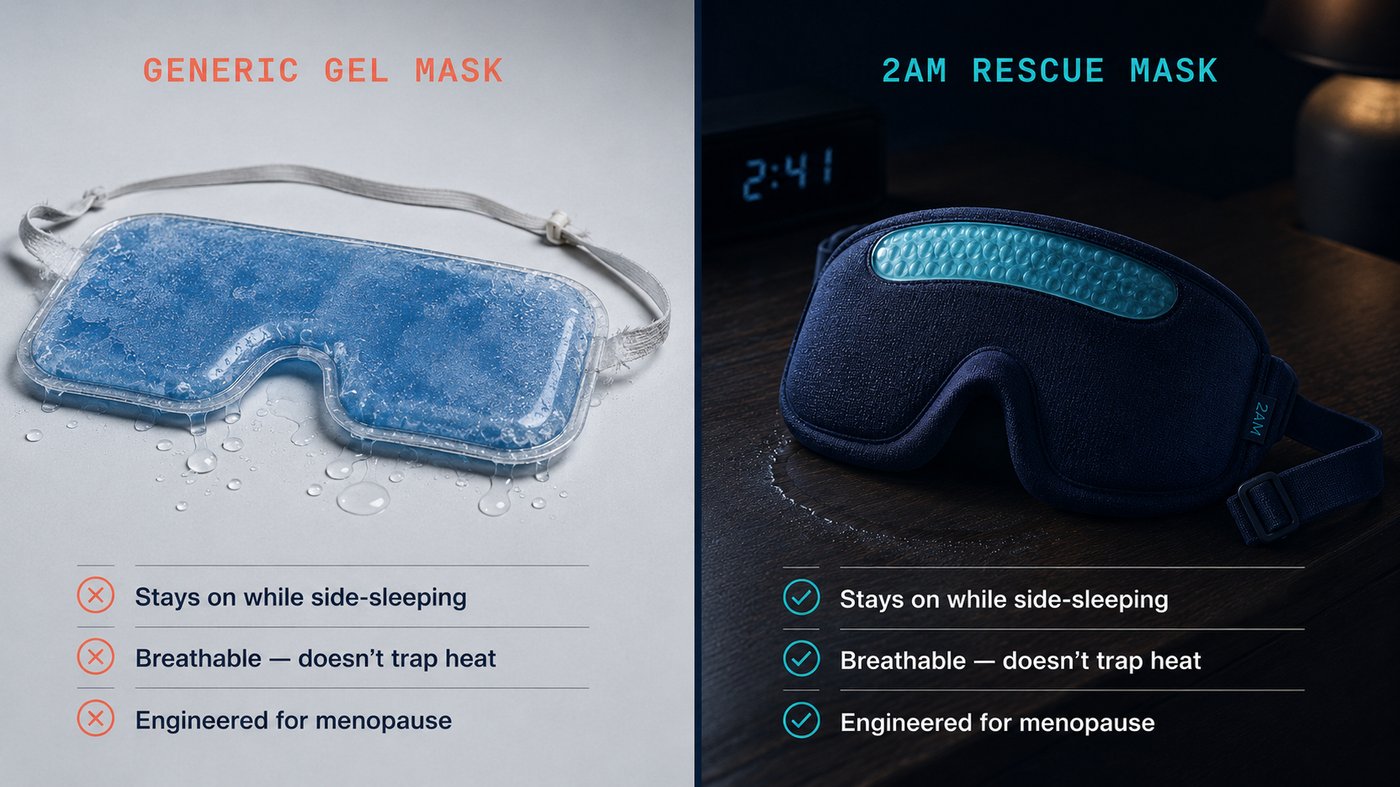
This was described differently. The gel insert was designed for the fridge, not the freezer — cold enough to trigger the reflex without freezing into something that feels like a brick against your face. The fabric was specifically constructed not to trap heat against the skin the way memory foam or thick silk does. And the strap was low-profile, designed for side-sleepers who move — not a flimsy elastic band, but something that would actually stay on through the night without digging into your ears or catching your hair.
I was skeptical. Obviously I was skeptical. I have a drawer full of skepticism that used to be money.
But I had the mechanism now. And for the first time, I was evaluating a product against a specific physiological need I understood — not against a marketing claim I had no framework to judge.
The Part I Hadn't Understood Yet
I messaged my therapist friend. I told her what I'd found and asked about the weighted component. She was quiet for a second and then said something that completed the picture for me.
"That's Deep Pressure Stimulation. It's the same principle as weighted blankets, but applied to the face — which has a much higher concentration of nerve endings. Weight applied gently to the eyes and forehead shifts the autonomic nervous system from sympathetic to parasympathetic. Fight-or-flight switches off. The body reads the pressure as safety. Cortisol drops. Serotonin goes up."
— Therapist friendSo the cold slows the racing heart via the vagus nerve.
The weight stops the anxiety spiral via the autonomic nervous system.
And the blackout — which I had been casually undermining every time I checked my phone or turned on the lamp to find a dry shirt — protects whatever melatonin is still left in the system. Because every photon of light that hits your retina at 3AM tells your brain it's time to be awake. The mask physically prevents that conversation from happening.
Three mechanisms. Cold, pressure, darkness.
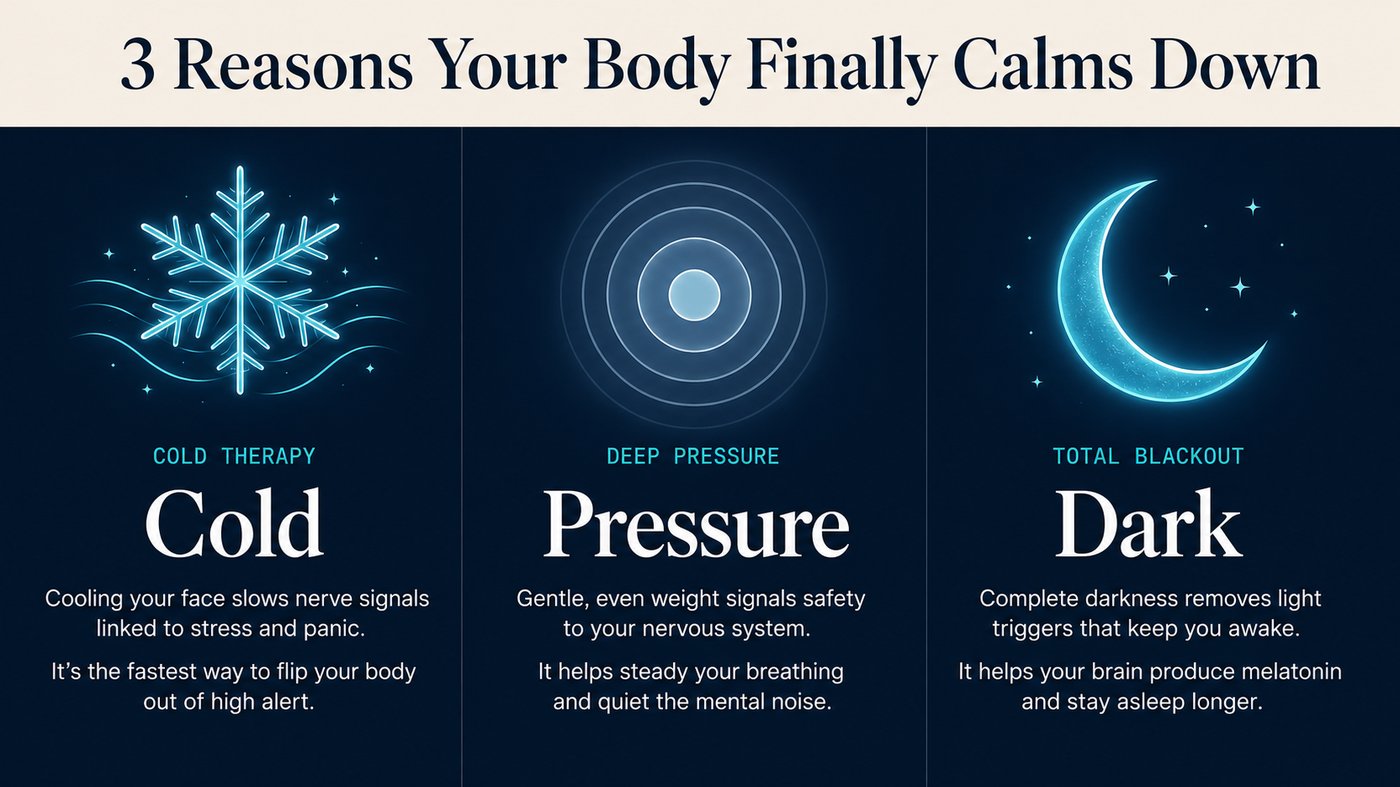
For the first time since this started, I was looking at something that addressed all three layers of what was happening to me at 3AM — not just the heat, but the panic behind it, and the melatonin sabotage on top of it.
I ordered it that night.
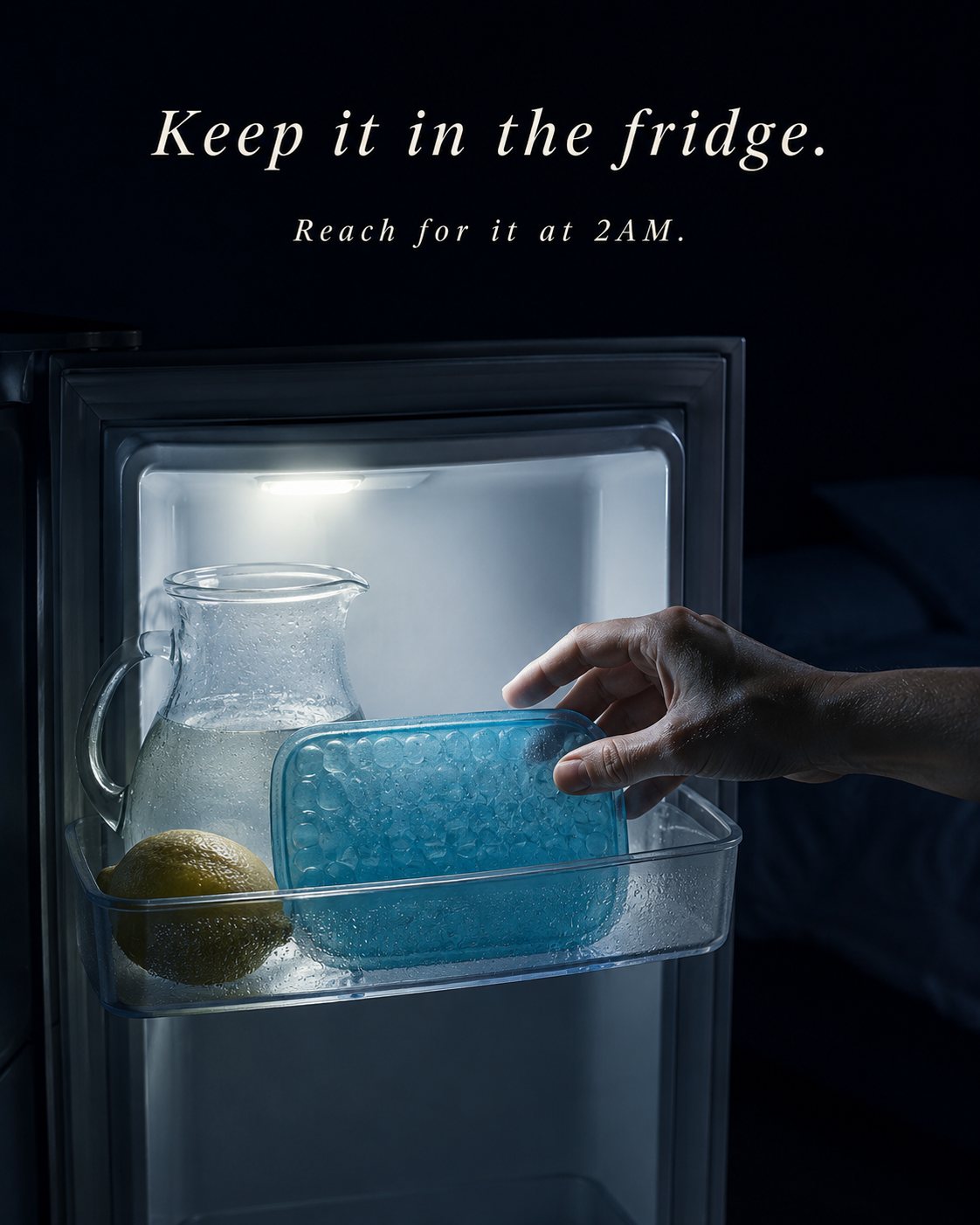
Cooling gel insert. Weighted pressure. Total blackout. Engineered for the exact 2AM moment — reach for it in the dark, feel your heart slow in 90 seconds.
The First Night
I'm not going to tell you it was miraculous. I've read too many reviews that promised miracles and I don't trust them.
Here's what actually happened.
I put the gel insert in the fridge before bed. I placed the mask on the nightstand. I went to sleep.
2:47 AM. The heat. The pounding. The familiar sick feeling of knowing I'm about to lose the next two hours.
I reached for the mask in the dark — no light, no phone, no husband disturbed — and pulled it over my eyes.
The cold was immediate. Not shocking-freezer cold, because it had been in the fridge, not the freezer. It was the temperature of cold water on a hot day. It covered my forehead, my closed eyelids, the bridge of my nose.
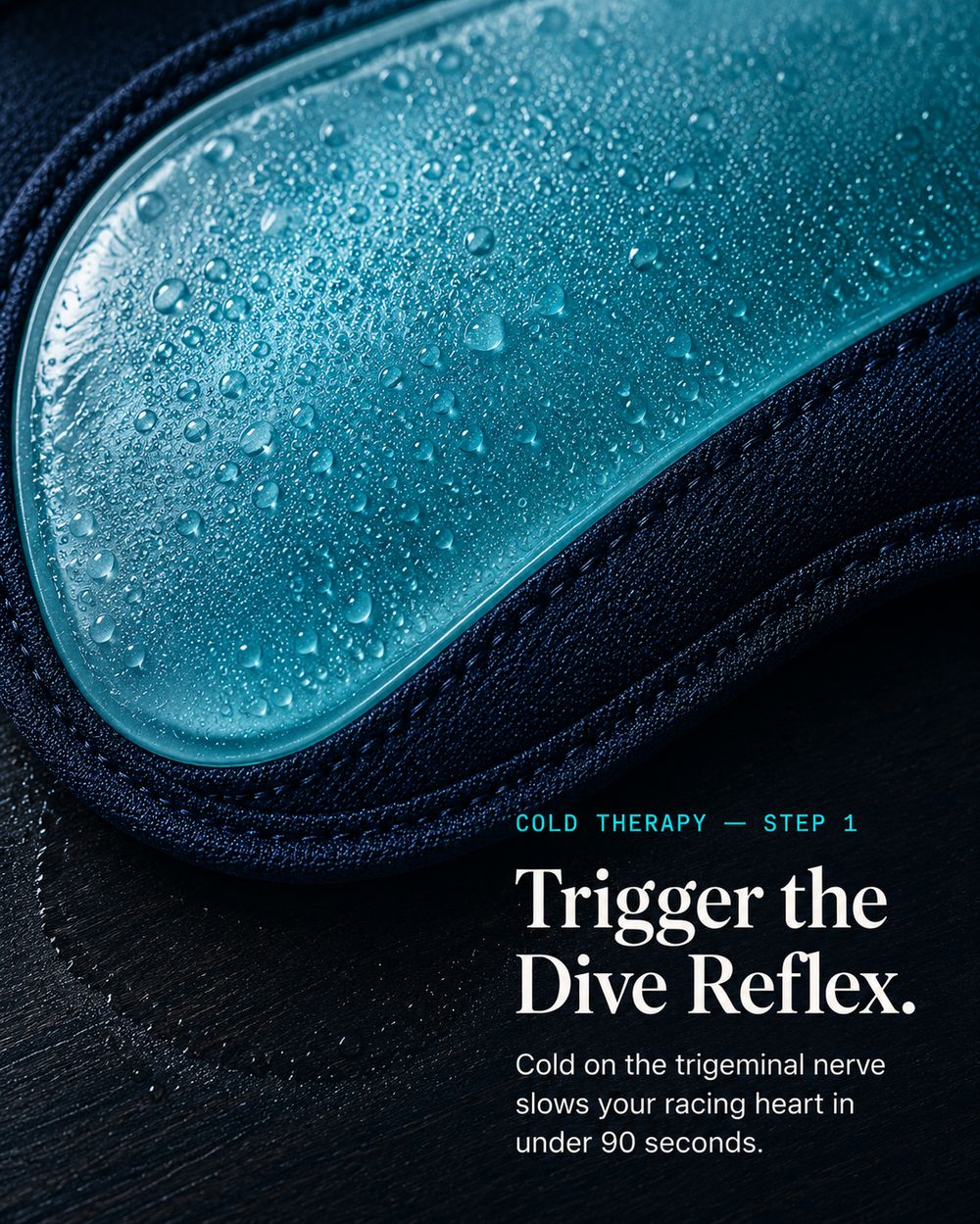
I had been afraid it would feel suffocating — one more layer trapping heat against my already overheated face. It didn't. The fabric breathed. The cold came through without heat building underneath it. That part surprised me.
I focused on breathing. I felt the weight of it settling across my face — not heavy enough to feel restrictive, but present. Grounding. Like a hand placed gently over your eyes by someone telling you it's okay to stop thinking now.
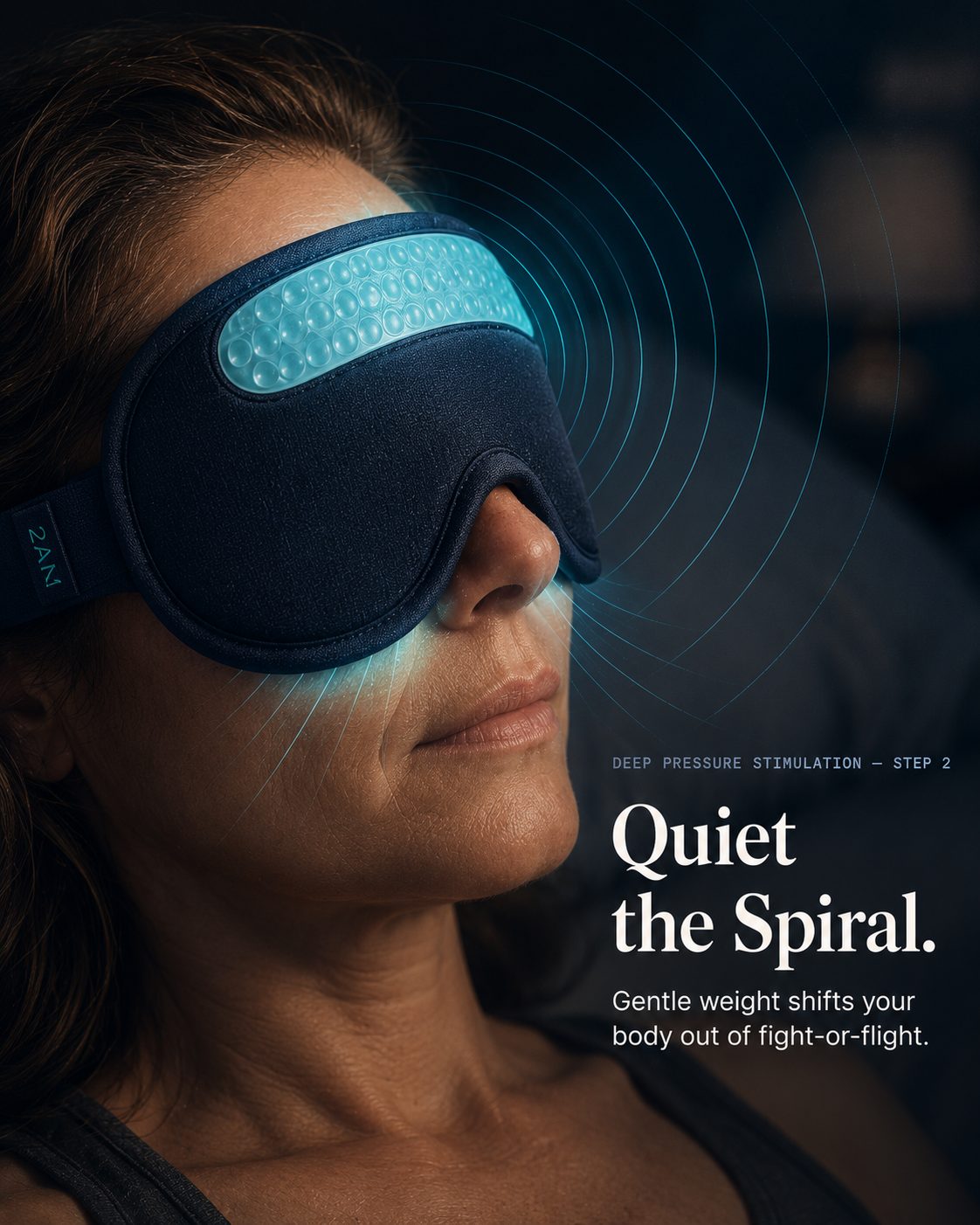
My heart rate, which had been hammering, started to slow. I know this because I could feel it — not from a monitor, just from the inside, the way you can feel your own pulse everywhere when it's elevated and then slowly stop feeling it when it isn't.
I was asleep before the cold had fully worn off.
I woke up at 6:50 AM.
The towel was still on the nightstand. It was dry.
What Has Changed
That was four months ago.
I still wake up some nights. Menopause doesn't stop because you bought a mask. But the 3AM scenario — the pounding heart, the anxiety spiral, the two-hour ceiling stare — that has not come back in its full form since. Most nights I reach for the mask, and I'm back asleep within fifteen to twenty minutes. Occasionally I sleep straight through.
The next-day difference is not subtle. I am not going to dress it up or make it sound like a transformation. It is simply that I have started waking up in the morning instead of dragging myself toward morning from inside an exhaustion that has no bottom.
The brain fog is not gone. But I can see through it now. The words come when I reach for them. I sat in a meeting last month and followed the entire thread of a conversation without losing my place. That hadn't happened in a long time.
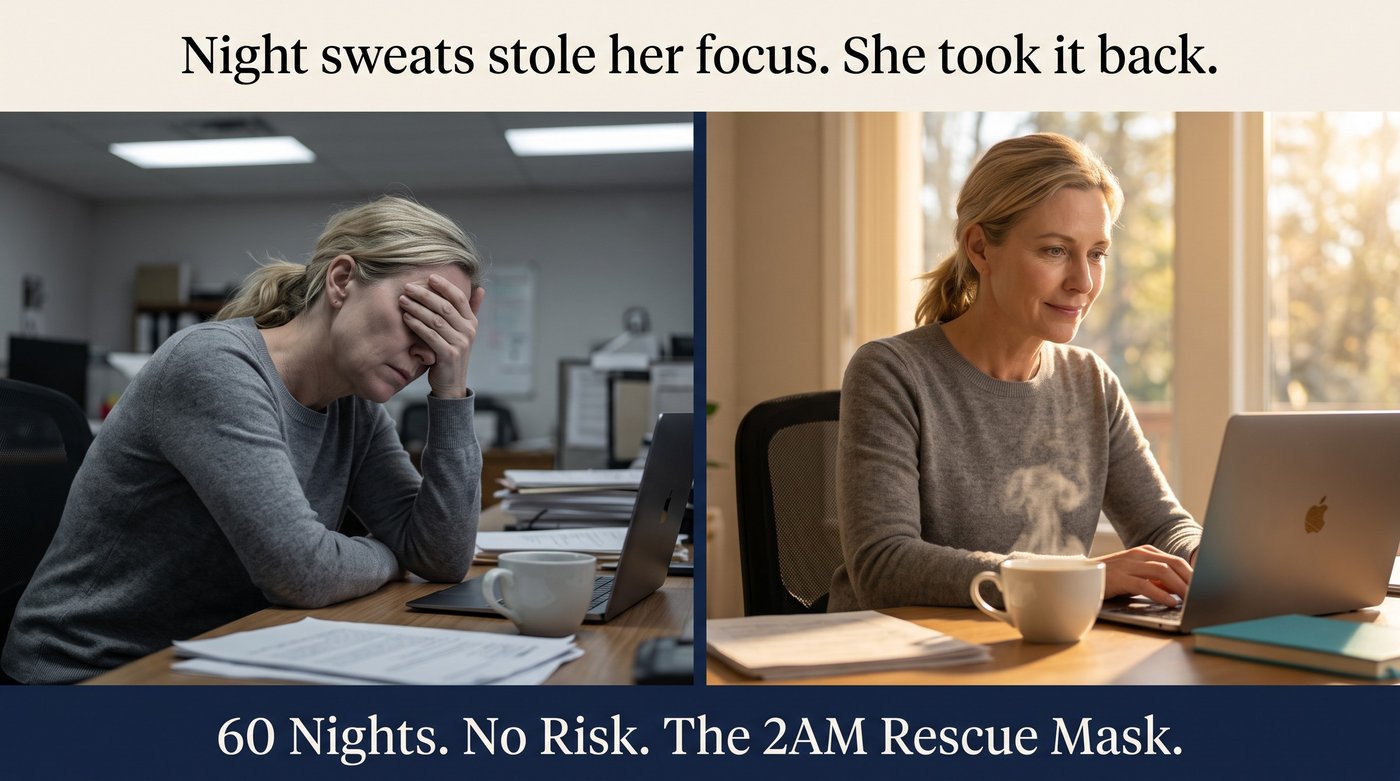
My husband asked me recently if I had a different pillow. I told him no. He said I seemed like I was sleeping better. I said yes.
He did not mention the towel. It was still there on the nightstand. But for the first time in three years, he has never once seen me reach for it.
That first morning I slept through, I sat in the kitchen with my coffee and watched the light come through the window. Nothing dramatic happened. I wasn't transformed. I was just — present. Not pre-exhausted. Not already counting the cost of the night before. I remembered what it felt like to arrive at the morning instead of merely outlasting it. The woman I used to be — the one with a second gear, the one who cared about things — she wasn't gone. She was just tired.

What Other Women Have Said
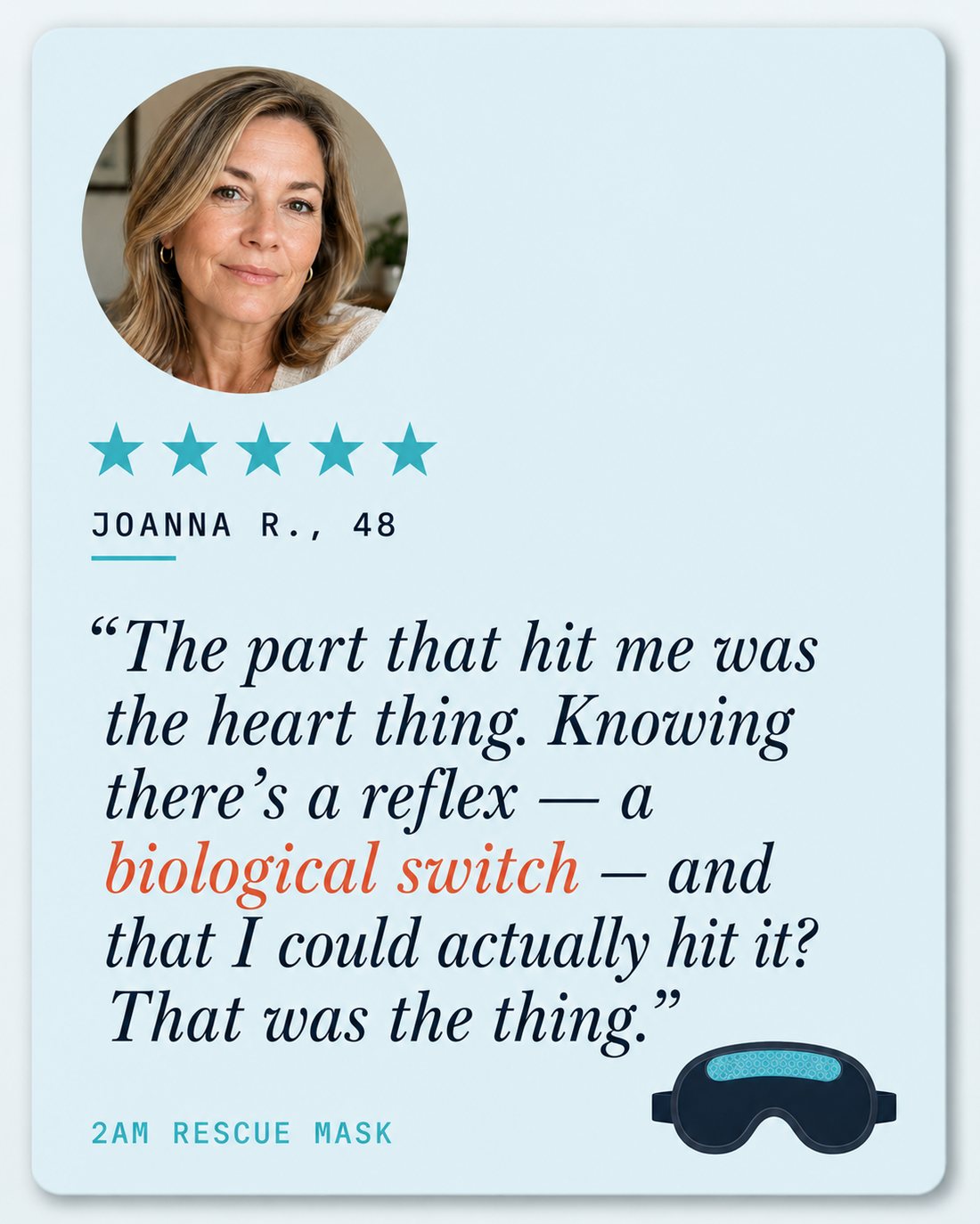
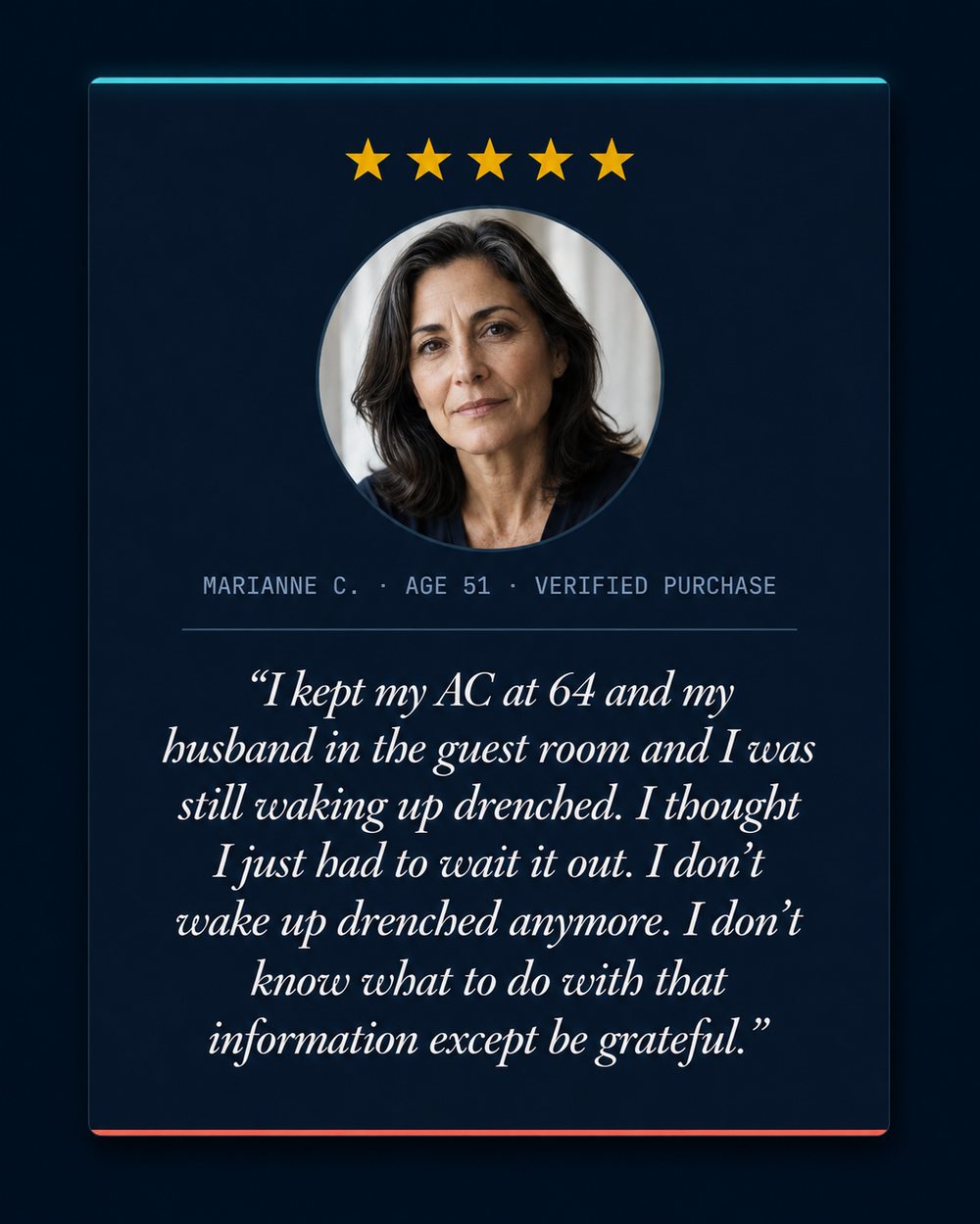
I shared what I'd found in the same forum thread where I first heard about it. The responses were — I don't have a more precise word for this — exhausted with relief. The kind of relief that has been waiting a long time and comes out slightly sideways.
If You're Where I Was
The towel sleeper. The floor mat. The $180 sheets that absorbed heat as quickly as they absorbed money. The late-night browser tabs on smart mattresses you couldn't quite justify. The doctor's office where someone suggested stress reduction.
I'm not telling you this is a cure. It is not a cure. It is a bedside rescue tool that works on a physiological mechanism that took me three years and one conversation with a therapist to understand.
The mask is called the 2AM Rescue Mask. It costs less than a single month of the supplements that didn't work, and a fraction of the cooling mattress I'd talked myself out of twice.
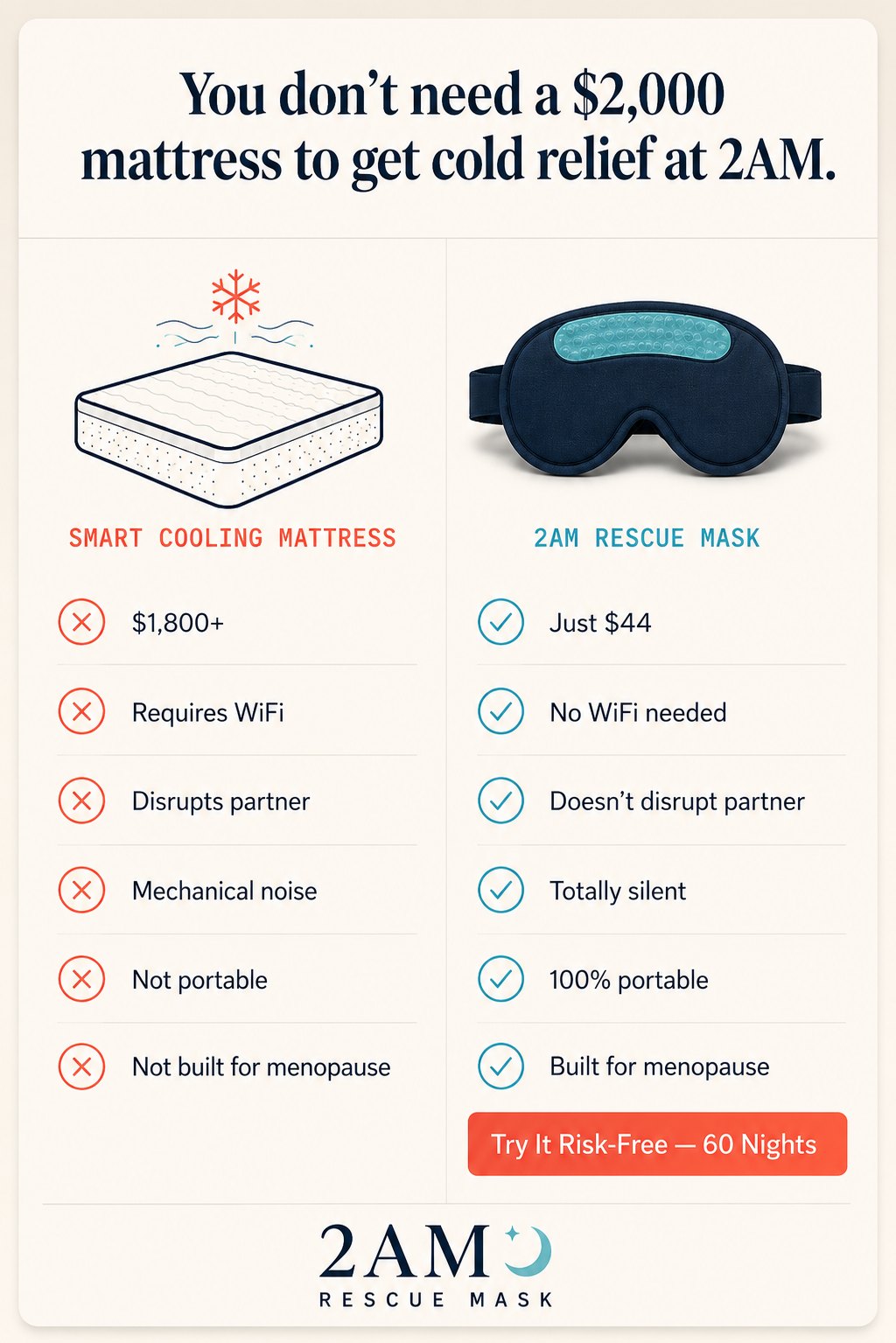
You press it over your eyes, feel the cold meet the center of your face, and let the reflex do what three years of sheets and supplements were never designed to do.
Save the Rest of Your Night.
The 2AM Rescue Mask is a comfort and wellness product. It is not a medical treatment and does not treat or cure menopause, hot flashes, or any clinical sleep disorder. Individual results vary. This article contains affiliate links — the author receives a small commission if you purchase through the link above, at no additional cost to you.